VOL. 004
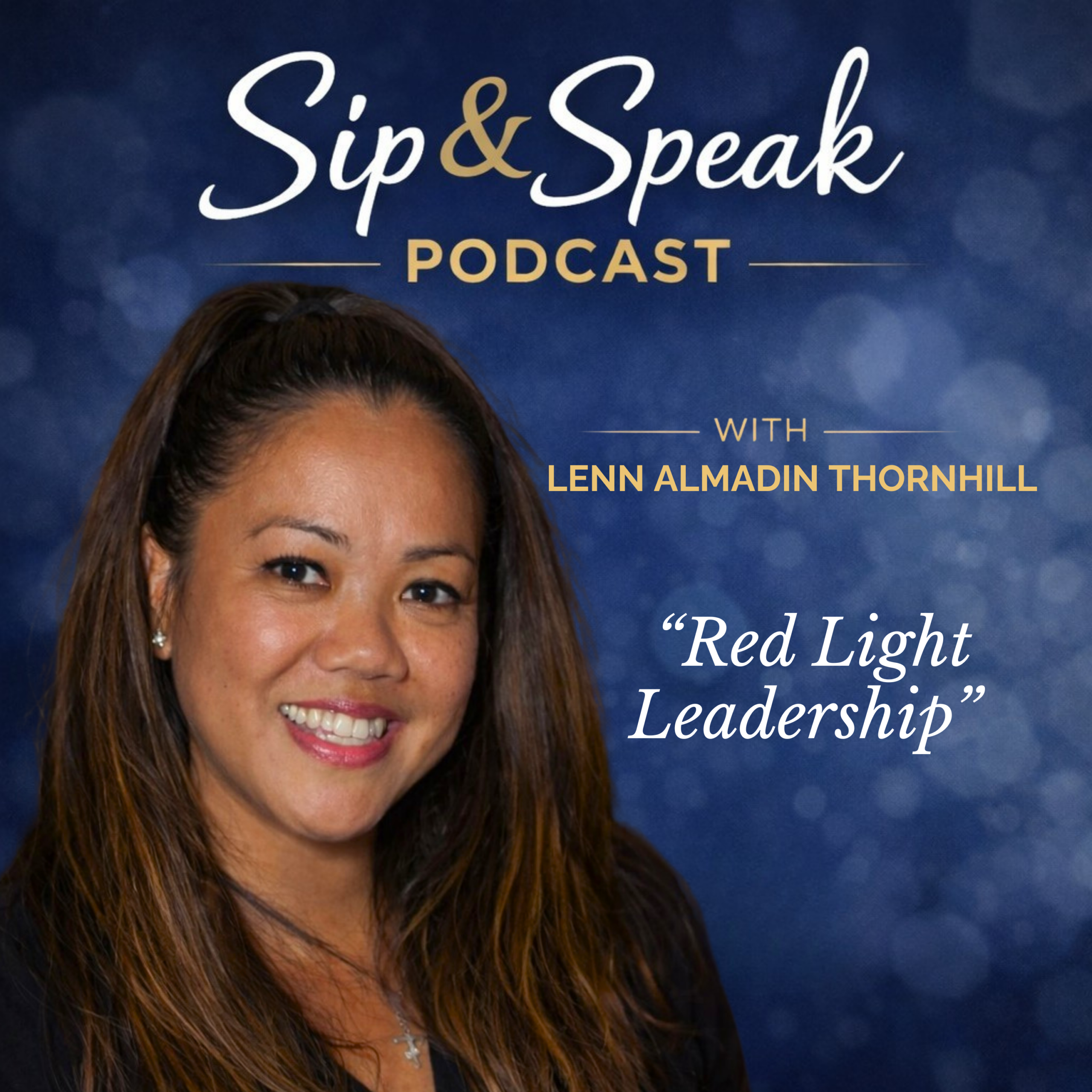
Lenn Almadin Thornhill
Journalist
But leaders have their own red light moments: board meetings, press conferences, crisis updates, keynote stages, investor calls, and high-stakes interviews where one slip becomes the headline. In this Sip & Speak conversation, I sat down with US journalist and former colleague Lenn Almadin Thornhill to extract what many executives underestimate: authority under pressure is not charisma. It’s a trained operating system.
Lenn’s answer was simple and non-negotiable: pause.
In breaking news environments, leaders often overcompensate—talking faster, getting louder, filling every second with sound. Lenn has watched it repeatedly at press conferences and high-pressure events. The result isn’t strength. It’s leakage: anxiety, lack of control, and disorganized thinking.
The common mistake is treating silence as weakness. It’s the opposite. Silence is a signal: “I’m in control of myself, so I can be trusted with the room.”
We also touched something most people don’t admit: audiences don’t need more words—they need more signal.
In live environments, “filling space” is almost always fear disguised as communication. Lenn described a simple self-interruption technique: if you catch yourself starting to overcompensate (“um,” “you know,” or repeating yourself), don’t spiral—pull back quickly and stop feeding it. You’re not trying to be perfect. You’re trying to be clean.
A dangerous belief among executives is: “I’m a natural talker. I’ll handle it live.” Lenn’s view is blunt: you can tell who prepared—even when they make it look effortless.
The practical approach isn’t writing a full script. It’s building bullet-point architecture:
Then you rehearse out loud. Not in your head. Out loud. If you only rehearse internally, you’re practicing thought—not delivery. Under pressure, thought collapses. Delivery must be conditioned.
In journalism, one wrong line can create legal exposure, reputational damage, or a cascade of retractions. Lenn explained a reality leaders should absorb: you don’t just worry about saying the wrong thing—you worry about saying the unverified thing too early.
“What we know at this time is…”
“We are still confirming…”
“Here’s what we can say with certainty…”
This protects credibility. And credibility is the real currency in crisis. If you make an error live, don’t pretend it didn’t happen. Lenn’s guidance was clear: acknowledge, correct, move forward. A clean correction builds trust faster than denial ever will.
Leaders fear Q&A because it removes control. Journalists don’t ask hard questions to be cruel. They ask hard questions to get clarity and to test whether the person speaking actually understands the subject—or is just repeating prepared lines.
Lenn said what many executives don’t want to hear: yes, questions can be designed to make you fumble, because fumbling reveals what’s real.
So what’s the winning move? Prepare for questions the way you prepare for risk. Not by memorizing answers, but by mastering a few response frameworks:
BRIDGE BACK TO CERTAINTY: “The key point is…”
DEFINE THE TERM: “When we say X, we mean…”
ANCHOR TO PUBLIC IMPACT: “Here’s what this means for people day-to-day…”
One of the strongest parts of the conversation was Lenn rejecting the myth that clarity equals simplicity. She framed it perfectly: translating technical content is like translating into another language. You’re not lowering the idea—you’re expanding access to it.
If you’re a leader speaking about complex topics—finance, policy, energy, innovation, security—your job is to connect it to what people already understand: groceries, bills, safety, jobs, time stability, trust.
That’s how authority lands. Not by sounding elevated, but by sounding relevant.
We discussed empathy because leaders often fear it will make them look weak. Lenn’s point: empathy isn’t a grand speech. It’s micro-behavior.
A touch on the shoulder. A small acknowledgment. A human sentence that shows you see the audience as people, not “stakeholders.” Empathy doesn’t replace strength. It prevents leadership from becoming mechanical.
The leaders who can be firm and human are the ones people follow when it counts.
Lenn offered a simple tactic that works in boardrooms and on camera: Focus on one person. One anchor point. One centering object.
If you try to hold eye contact with everyone, you’ll overload. Scan the room, but keep returning to a stabilizing focal point. This reduces anxiety and instantly improves vocal control.
We also talked about the future of news and the modern credibility landscape: short-form content is everywhere, but people still want full context. Long-form storytelling still matters. Traditional journalism is not disappearing; it’s being reshaped by platforms, audience behavior, and emerging tools like AI.
Credibility compounds when you show up consistently with a clear message and disciplined delivery.
This full conversation with US journalist Lenn Almadin Thornhill is available on the Sip & Speak Podcast.